Ancient St John’s church in Medway’s riverside Halling will be keeping its patronal festival with an open evening.
Wednesday 24 June is St John’s Day when the church is opening from 6-9pm offering free refreshments and a chance to have go at bellringing.
The village has long been on the Pilgrims’ Way as it maintained one of the ferries for crossing the River Medway.
Now the main crossing is Peters Bridge at the south end of Halling. This means that whilst once pilgrims might have split up to cross at Cuxton or Snodland now they head for the bridge.
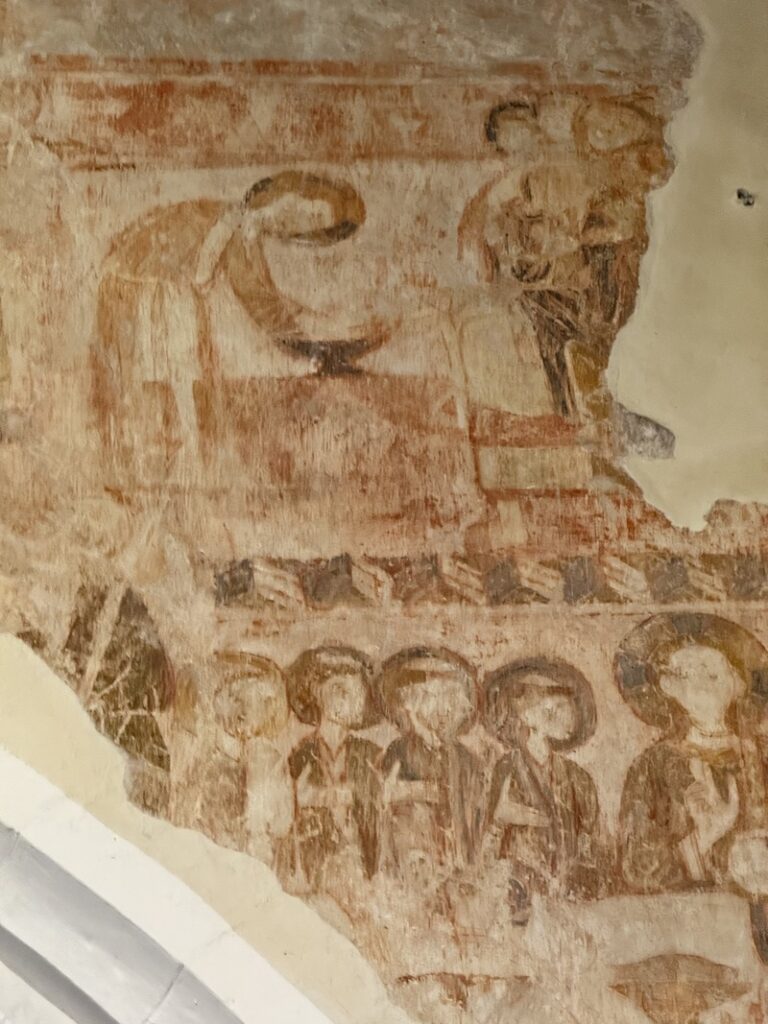
Halling church, dating from the Norman period, has just restored its 13th-century chancel arch paintings featuring the Crown of Thorns, the Washing of the Feet and the Last Supper.
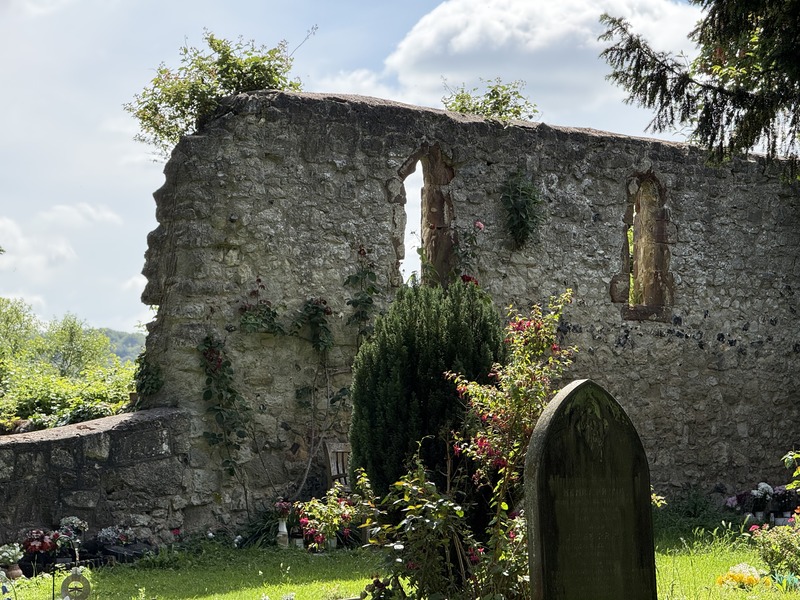
The churchyard’s wall with lancet windows was the west end of the dining hall belonging to the Bishop of Rochester’s palace.
The church is not at present open daily but it is open weekends 10am-12 noon: Saturday during choir practice and Sunday when the service (Holy Communion/Eucharist) is at 11am.
A pilgrim stamp is available by the hymn books on the back pew. When the church is closed a stamp can be obtained at The Five Bells opposite or in the early morning at Jo’s Cafe coffee stall outside at the pub.
The Halling stampPart of the 13th-century wall paintingHalling churchyard’s palace wall
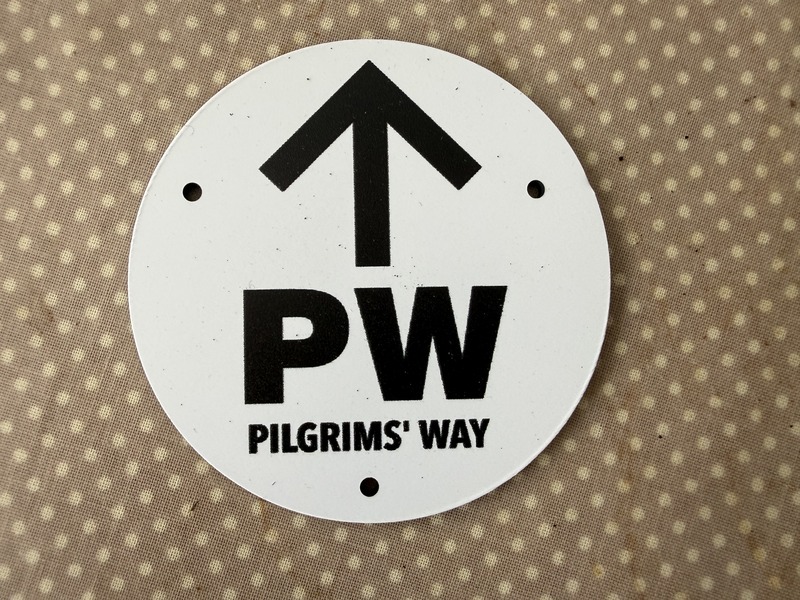
Soon there will be handy PW waymarks found along the route.
The plan is to start in places where they are most needed -for example where the PW is not over the same ground as the North Downs Way.
If there are any places where you have briefly felt confused let us know in the replies/comments. We are looking at both the legs out of Southwark and Winchester as well as the shared path from Otford.
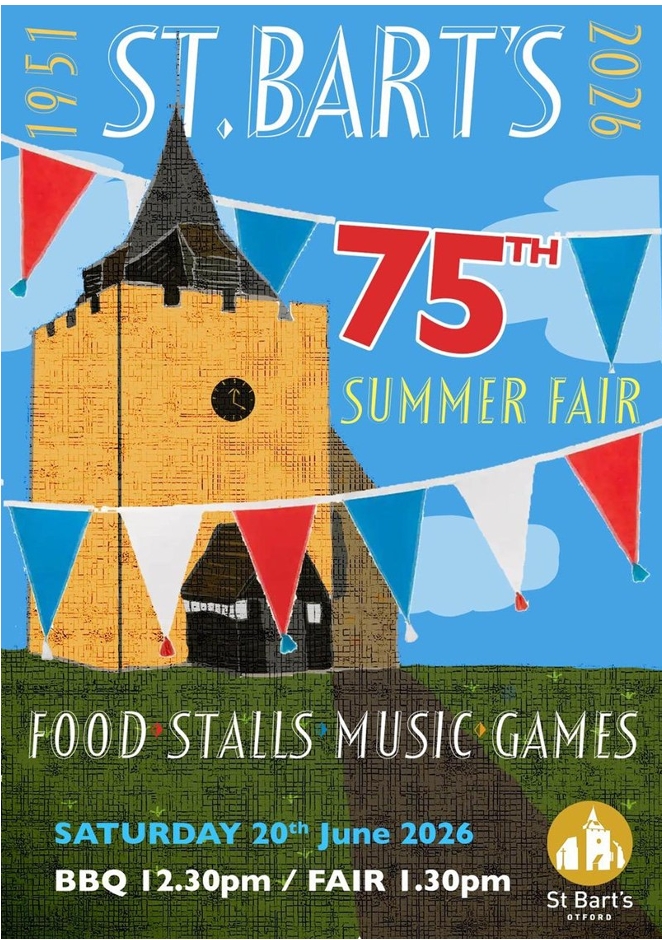
This is the 75th year for the Bart’s Summer Fair at Otford.
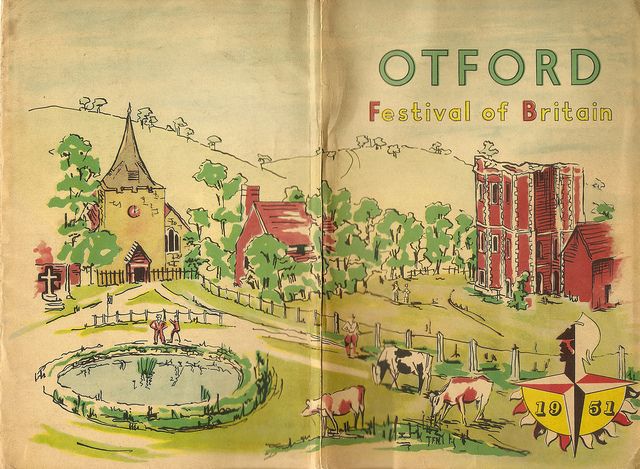
It was first held in Festival of Britain year 1951 when Abram Games designed the village’s guide book cover. He had been responsible for the official Festival emblem, known as the Festival Star.
Otford in Kent is where the Southwark and Winchester arms of the Pilgrims’ Way come together at St Bartholomew’s church by the pond.
Expected stalls at this year’s fair on the green include: books, plants, white elephant, cakes, raffle, coconut shy and ice cream. .
There will be games for children as well as a bouncy castle.
Lunch and teas will be available.
Abraham Games cover featuring church and palace where royalty and bishops stayed on the way to and from Canterbury
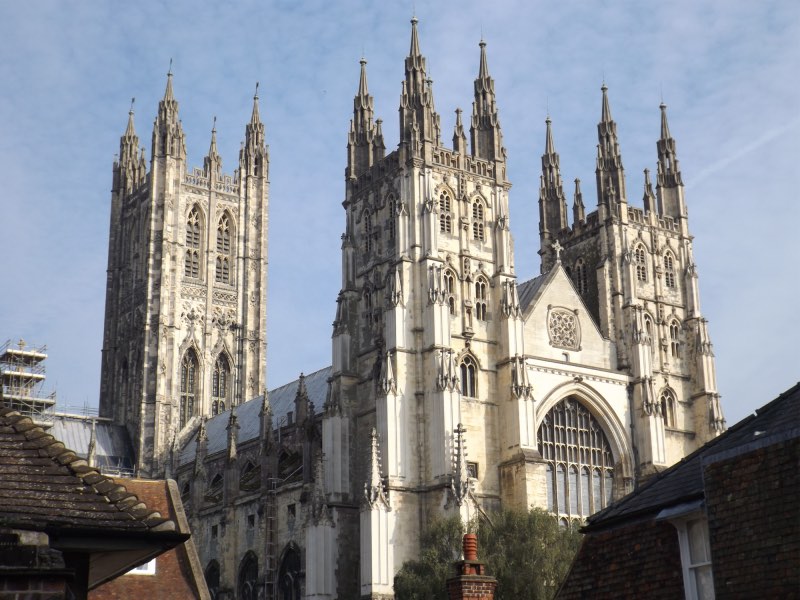
In 1162 St Thomas Becket was consecrated bishop in Canterbury Cathedral on the Sunday after Whitsun having been ordained priest on the previous day.
He subsequently promoted that Sunday as Trinity Sunday annually ahead of its universal adoption under Pope John XXII in 1334.
Pope John also introduced Corpus Christi on the Thursday after Trinity Sunday.
In 1162 Trinity Sunday and Corpus Christi were already being observed on today’s moveable dates in Liege and Benedictine monasteries including Cluny Abbey.
Although Winchester Cathedral is dedicated to the Holy Trinity this only dates from Henry VIII’s reign and is in addition to the older and more popular St Peter and St Paul and St Swithun.
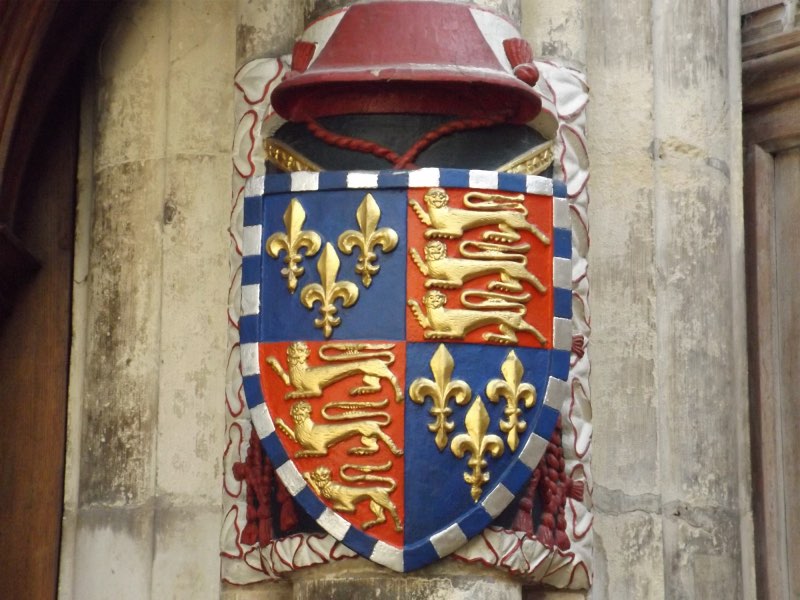
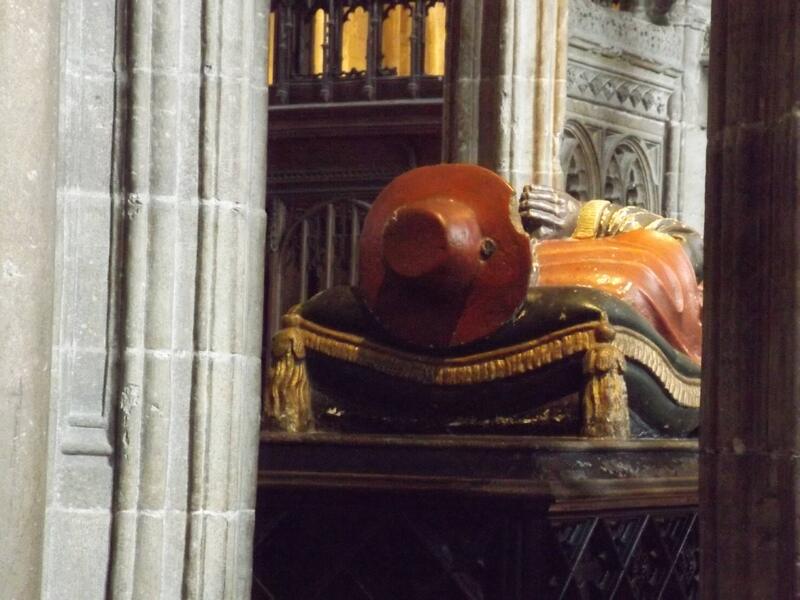
The Beaufort arms with the hat, or galero, as part of the achievement of the coat of arms in SouthWark Cathedral.
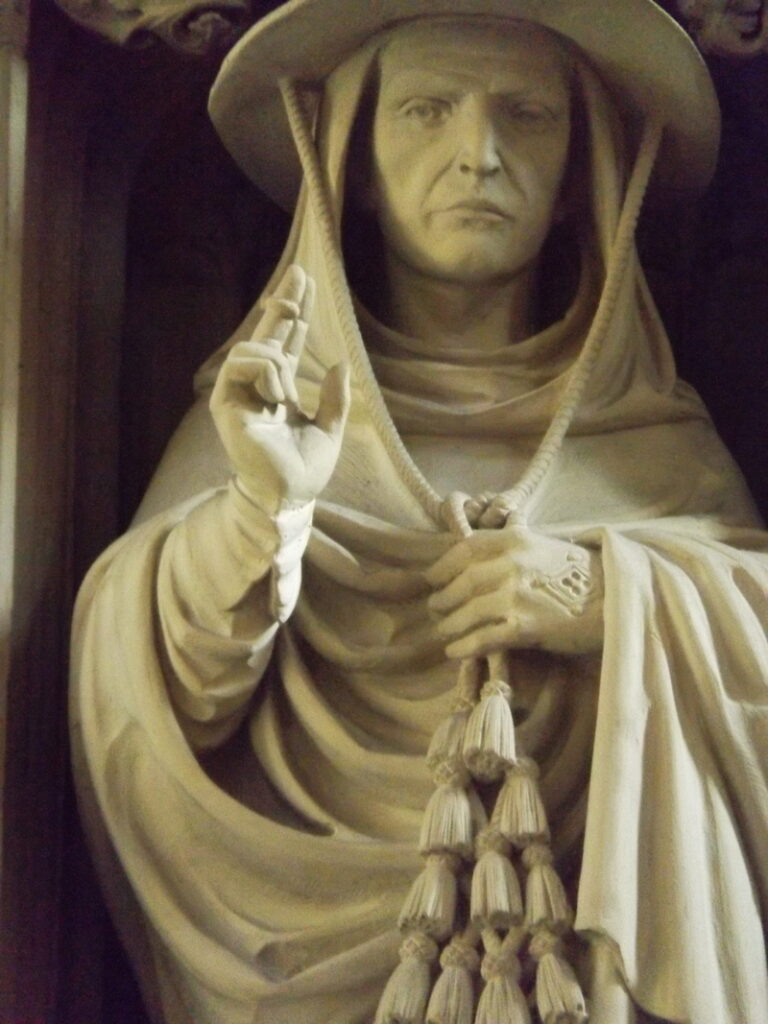
Henry Beaufort was made a cardinal 600 years ago this week: May 1426.
If you start your pilgrimage at Southwark Cathedral you see his shield with its red cardinal’s hat in the south transept.
But if you are setting out from Winchester you find his magnificent tomb alongside St Swithun’s shrine. Bishop Beaufort is depicted wearing his hat.
The broad-brimmed and low-crowned red hat, or galero, dates from the 13th century and was originally a pilgrim hat to shade one’s head from the sun.
Henry Beaufort had royal blood but was barred from the line of succession due to having been born out of wedlock. However, he was Chancellor three times and in office when Henry V won at Agincourt.
Also significant was his concurrent appointment as Bishop of Winchester. The Winchester Diocese embraced Southwark and Bishop Beaufort lived for over forty years at Winchester Palace next to Southwark Cathedral -then known as Southwark Priory.
In 1424 Beaufort presided at the wedding of his niece Joan to the King of Scotland at the priory. The wedding breakfast was next door in the bishop’s great hall whose remains can be seen in Clink Street.
But Beaufort was still not a cardinal. The Archbishop of Canterbury was against the Bishop of Winchester having such a status and Henry V had feared that the wealthy and dominant bishop might become a second Becket.
It may not have helped that Beaufort had gone on pilgrimage to Santiago de Compostela in preference to attending the King’s wedding at Troyes Cathedral in France.
Bishop Henry’s diplomatic letters to Henry V were sometimes composed by his cousin Thomas Chaucer who was constable of an episcopal residence and acted as his diocesan agent. Thomas, who was also close to the King, was son of Geoffrey Chaucer.
The nomination by Pope Martin on 24 May 1426 was early in Henry VI’s reign. But it was not until the following year that Bishop Beaufort received official promotion .
In March 1427 he landed in Calais to be unexpectedly welcomed by a messenger from Rome confirming his elevation. Three weeks later, on the Feast of The Annunciation 25 March, he went to the town’s Church of Notre Dame to be presented at last with the red hat.
***There has been a mistaken belief that Beaufort was present at Joan of Arc’s trial and death. As a result Winchester Cathedral’s St Joan statue looks towards the Beaufort tomb. The bishop also lived at Farnham Castle (on the Pilgrims’ Way) which led to the decision in 1929 to dedicate the town’s Roman Catholic church to St Joan.
Carinal Baeufort wearing his hat in Winchester CathedralCardinal Beaufort depicted with the tassels of his hat on the Great Screen in Southwark Cathedral.
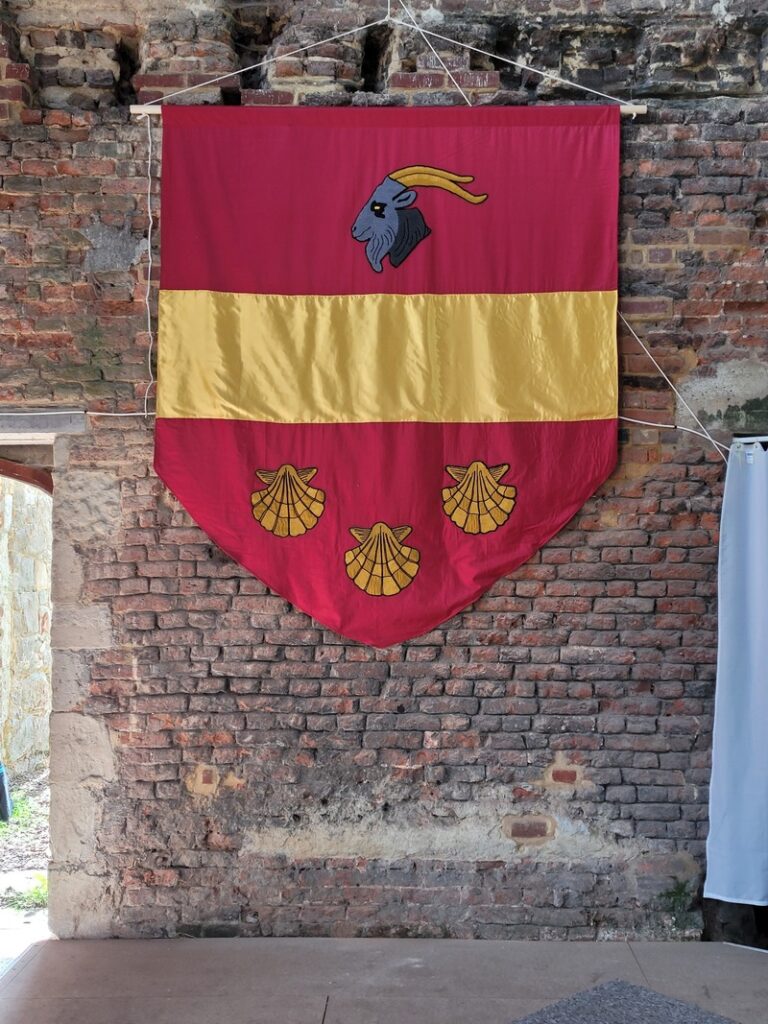
A large banner based on Archbishop William Warham’s shield is now hanging in the tower at Oford Palace.
The new attraction is the work of Jacky Gulczynski.
The heraldic features include a goat’s head and three pilgrim shells.
The Archbishop’s shield can be seen on his tomb close to the Martyrdom in Canterbury Cathedral. It is said that he chose to be buried as near as possible to the spot where Thomas Becket was murdered.
Archbishop Warham rebuilt Otford Palace which was so impressive that it was the model for Cardinal Wolsey’s Hampton Court Palace.
Warham crowned Henry VIII and presided at his wedding to Katharine of Aragon. The couple stayed at Otford Palace on their way to Canterbury.
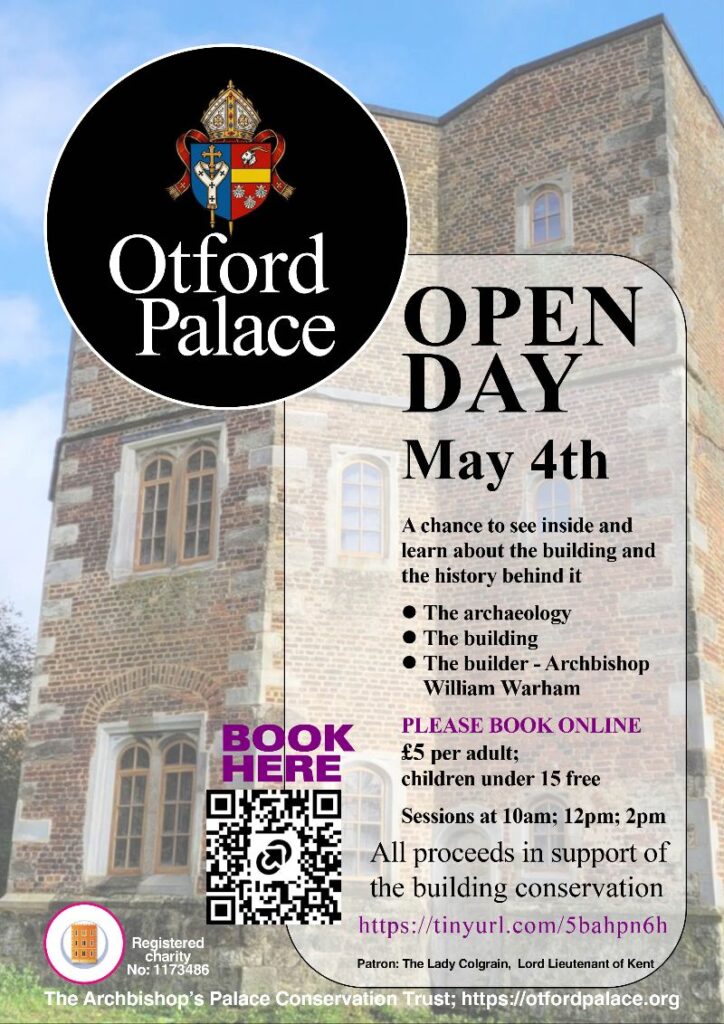
Only a small part of the palace survives today. The tower will be open on May Bank Holiday Monday. Booking is advised.
***Otford in Kent is where the two arms of the Pilgrims’ Way, from Southwark and Winchester, converge.
This weekend’s Sunday is the Third Sunday of Easter which means that St Aphege does not get much of a mention this year. In some years he is overtaken by Easter Week.
But 19 April is St Alphege’s Day.
Alphege was Bishop of Winchester and then Archbishop of Canterbury. He was martyred in Greenwich by Danish invaders in 1012.
Maybe it was the manner of his death which caused his successor Thomas Becket to invoke the name as he was murdered in the next century.
Alphege took the head of St Swithun with him when he was translated to Canterbury.
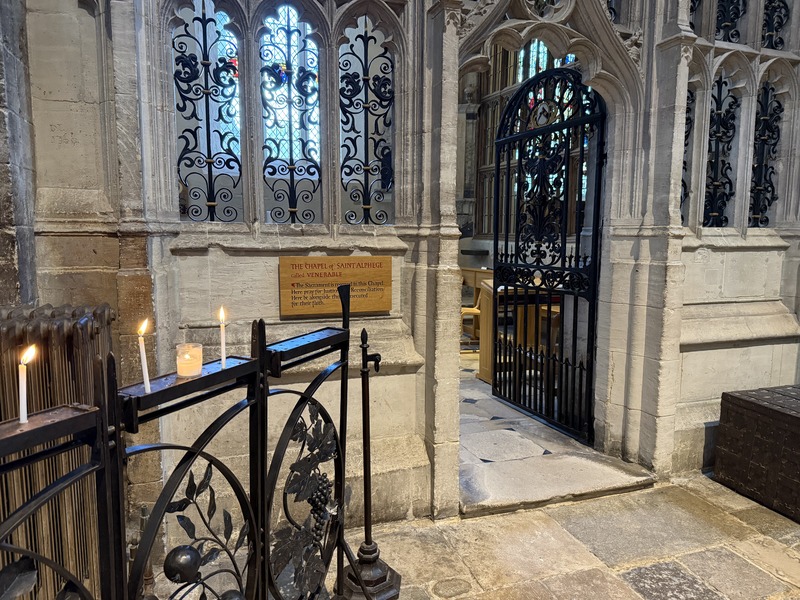
You can start your pilgrimage to Canterbury by visiting not only the St Swithun shrine site in Winchester Cathedral but also the St Alphege Chapel on the south side.
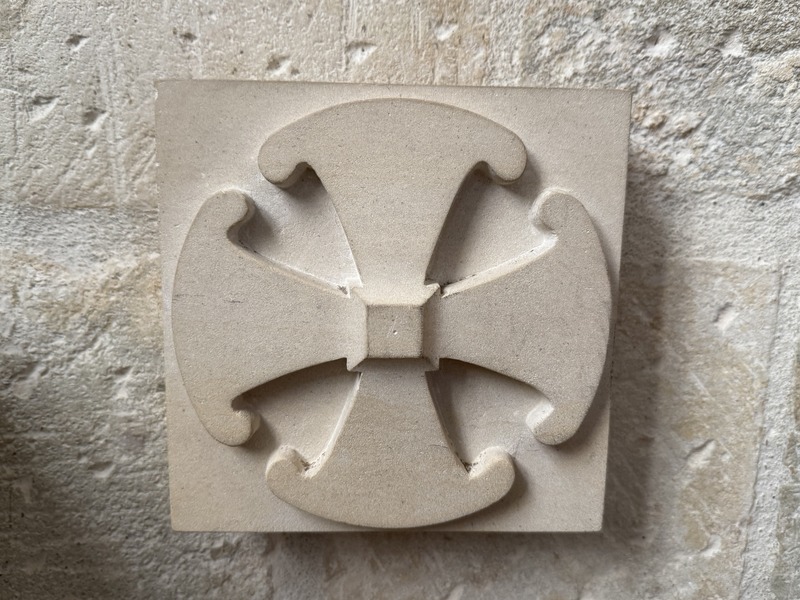
There you will find a carved stone Canterbury cross. This is based on a 9th-century bronze brooch found in Canterbury and now reproduced both as a souvenir and in stone to be sent to other cathedrals. One is also found at Bec Abbey which was the mother house of Archbishop Theobald of Bec -Thomas Becket’s immediate predecessor.
The Canterbury Cross in Winchester Cathedral’s St Alphege Chapel
The Dirty Habit pub in Hollingbourne will reopen in May.
The inn has been closed since October 2022 when it was badly damaged by fire.
Drinks and food should be available from Tuesday 5 May before the all day ‘grand re-opening party’ on Saturday 9 May which is open to all.
The Pilgrims’ Way runs along the north side of the building which is claimed as ‘having developed from an 11th-century monks ‘ ale and cider house’. The now mainly early Georgian building has ’13th- century country pub’ written above the front windows.
As an inn It was long called Ye Olde Pilgrim’s Rest until 1727 when the name was changed to the King’s Head. The original name was restored as The Pilgrim’s Rest in 1975 but this century it been called The Dirty Habit.
Today’s name refers to the monks habits being stained as they harvested grapes in the surrounding vineyards and produced wine.
The Manor of Hollingbourne belonged to the monastic community of Canterbury Cathedral. In Domesday book the village is recorded as ‘the land of the monks of the archbishop’.
This ownership was confirmed by Henry II who granted a charter to the Prior and monks of Canterbury.
There are plans for The Dirty Habit to offer accommodation later in the year.
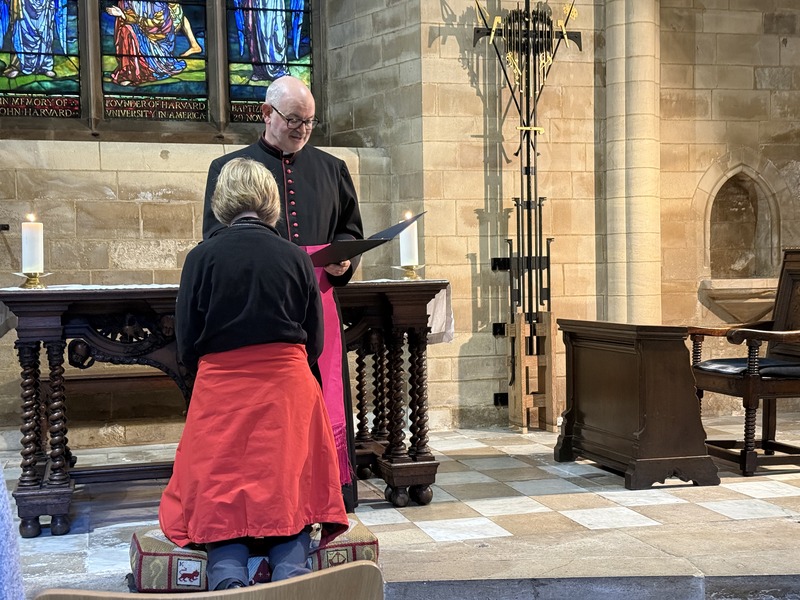
Archbishop Sarah receiving a pilgrim blessing from the Dean in Southwark Cathedral’s Harvard Chapel
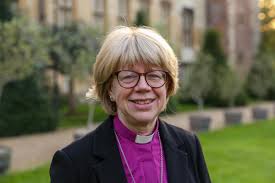
Archbishop Sarah Mullally has begun her pilgrimage to Canterbury by calling at Southwark Cathedral for a blessing.
Earlier Archbishop Sarah had set out from St Paul’s, her former cathedral seat, and crossed the River Thames to Bankside.
She will be arriving at Canterbury Cathedral for her enthronement as Primate of All England on foot as thousands of pilgrims have before her.
‘As I prepare for my installation at Canterbury Cathedral, it feels deeply humbling to be following in the footsteps of those who have walked this ancient route,’ commented the Archbishop on her first day.
On Wednesday she will be enthroned in the Chair of St Augustine during the installation service marking the start of her public ministry as Archbishop of Canterbury.
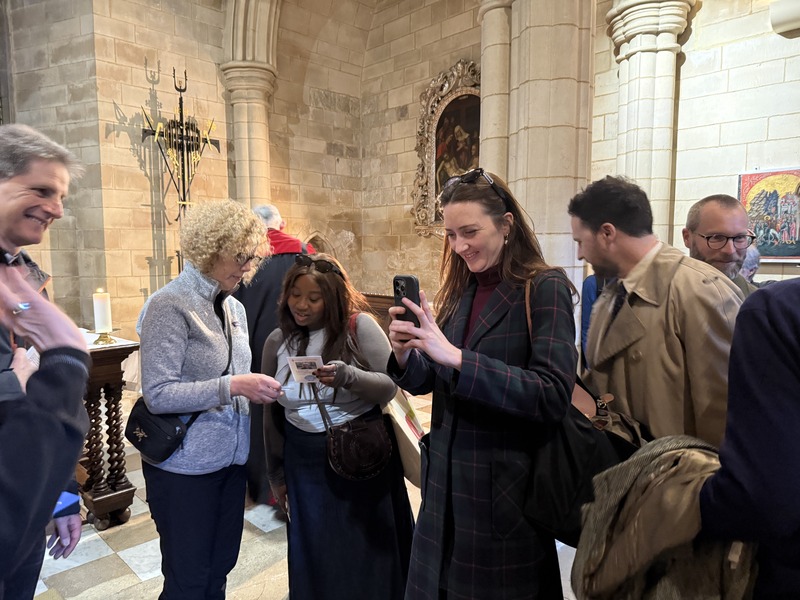
The party walking with the Archbishop gathered in the Harvard Chapel where the Dean of Southwark, the Very Revd Mark Oakley, reminded everyone that her predecessor, martyr Thomas Becket, made his last journey to Canterbury from Southwark.
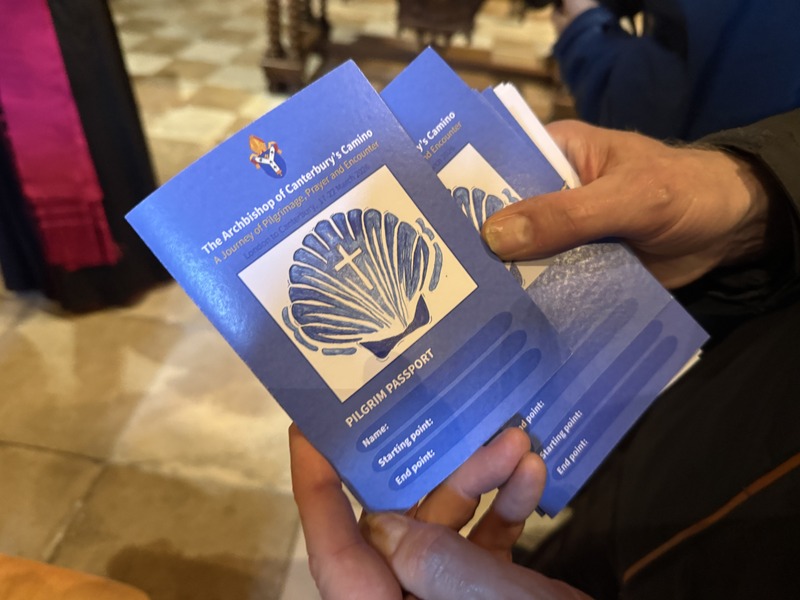
Verger Robert Biden stamped the pilgrim passport designed by pupils from Ospringe Church of England Primary School in Faversham.
Among those present to see the Archbishop leave were former editor of The Times Sir Simon Jenkins and historian Alice Loxton.
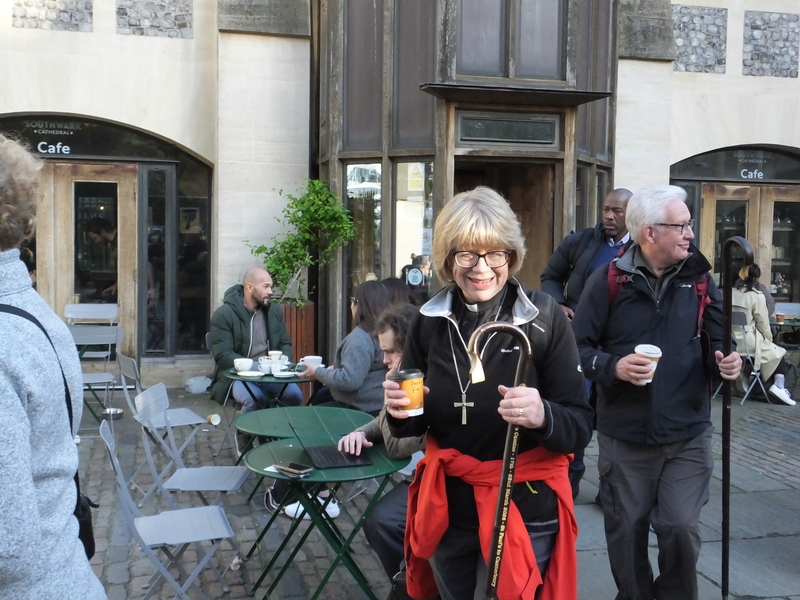
Walking with the Archbishop and her husband Eamonn is Canterbury Cathedral’s Pilgrimage Officer Torin Brown.
Arrival at Canterbury is planned for Sunday afternoon.
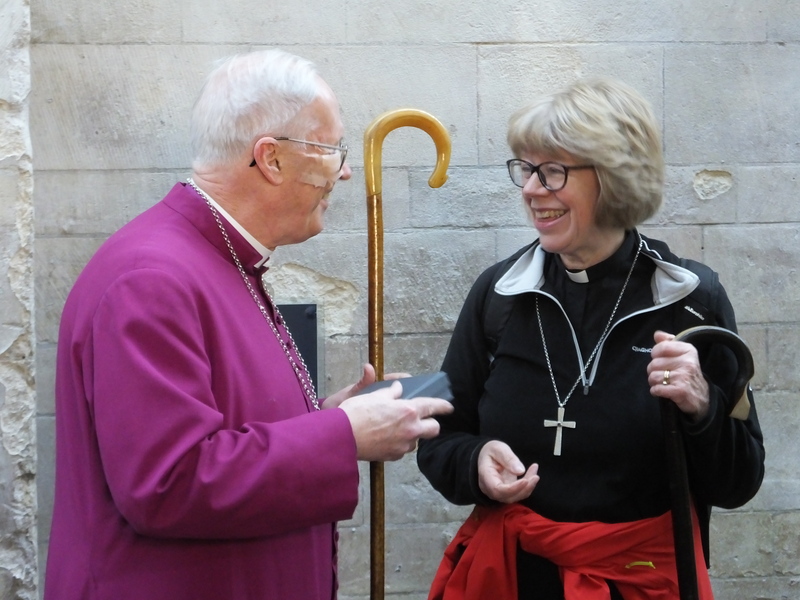
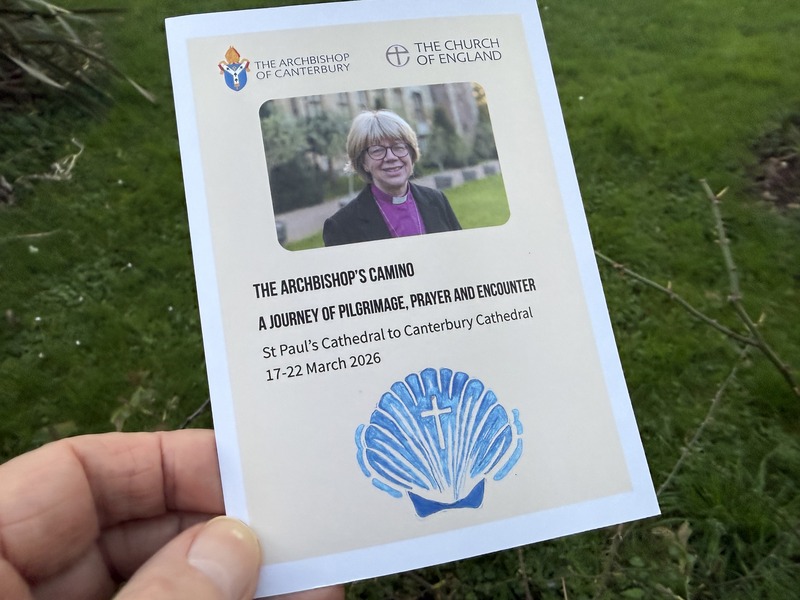
The Bishop of Southwark with the Archbishop on arrival at SouthwarkThe special pilgrim passport for Archbishop Sarah’s walk. The pilgrim shell was designed by pupils of Ospringe Church of England Primary School in Faversham.Alice Loxton recording the occasionArchbishop Sarah visited the cathedral’s Comptoir Bakery cafe before leaving A prayer card is being handed to those meeting the Archbishop on her 90 mile walk.
The new Archbishop of Canterbury Sarah Mullally is to leave London on foot for her enthronement at Canterbury Cathedral.
‘As I prepare for my installation at Canterbury Cathedral, it feels deeply humbling to be following in the footsteps of those who have walked this ancient route,’ says Archbishop Sarah.
On St Patrick’s Day next Tuesday, she will leave from St Paul’s Cathedral before crossing the Thames to Southwark Cathedral. Walking with her husband Eamonn, she plans to reflect on her journey from Bishop of London to Archbishop of Canterbury.
A special pilgrim passport has been produced for the journey by pupils from Ospringe Church of England Primary School in Faversham.
The Archbishop’s walking party, which will include Canterbury Cathedral pilgrim officer Torin Brown, is to give out cards featuring a prayer written by pupils from The Archbishop’s School in Canterbury.
The plan is to arrive at Canterbury on Passion Sunday afternoon 22 March before evensong .
Archbishop Sarah is to be installed as primate three days later on the Feast of the Annunciation.
‘For centuries, faithful pilgrims have flocked to Canterbury, and I will be reflecting on this tradition as we make our way through the Kent countryside and its towns and cities,’ says the new Archbishop.
‘I’m looking forward to visiting local churches, cathedrals and holy sites along the route – and to meeting people, praying with them and hearing their stories. As I walk this path I will be praying for our Church and our world, and asking God to bless those we meet.
‘Every Christian life is a pilgrimage – a journey with God. As I begin this new chapter in my own life and ministry, I am grateful to be walking with God and with others.’
To Canterbury from Winchester and London / Leigh Hatts